

National Pollution Discharge Elimination System (NPDES) Permitting
SEC confidently supports facilities in achieving stormwater and wastewater compliance, meeting the Clean Water Act requirements, and securing permits efficiently.
NPDES Permits & Regulatory Compliance
Understanding NPDES Permitting Program
The National Pollutant Discharge Elimination System (NPDES) program regulates the discharge of pollutants from point sources into the waters of the United States. Point sources refer to any discernible and discrete conveyance (e.g. outfall, pipe, ditch, conduit, etc.), while pollutants include industrial, municipal, or agricultural waste discharges (e.g. dredged soil, solid waste, sewage, chemical waste, used oil, etc.). Authorized under Section 402 of the Clean Water Act (CWA), dischargers are required to obtain permits that specify discharge limits, monitoring requirements, and pollution control measures to protect water quality and public health.
Who Needs an NPDES Permit?
NPDES permits are required for any facility that discharges pollutants from a point source into a US waterbody (e.g. tributaries, navigable waters, wetland, etc.). Pollutant discharges allowed by NPDES Permits may include process wastewater, non-contact cooling water, and stormwater runoff impacted by industrial activity. Permits are typically valid for five years and must be renewed at least 180 days before expiration to avoid coverage lapses or backlogs. Discharges into the municipal sanitary sewer system do not require NPDES permits, but they may still be regulated under other programs such as Pretreatment Standards or Industrial Stormwater Permitting.
Types of NPDES Permits
There are two main types of NPDES permits:
-
- Individual Permits – Tailored to the specific operations and discharge characteristics of a single facility. These permits involve a full application, review, and public notice process, and must be submitted 180 days prior to the expected start of discharge.
-
General Permits – Apply to multiple facilities with similar operations and discharge types. The process is streamlined through submissions of Notice of Intent (NOI).
-
Construction General Permit – Used for stormwater discharges from construction activities and land-disturbing projects (e.g., clearing, grading, excavation).
-
Multisector General Permit (MSGP) – Used for stormwater discharges associated with industrial activities across various sectors such as manufacturing, transportation, timber, and mining operations.
-
Other State-Specific General Permits (if applicable) – Many states issue additional sector or activity-based general permits for areas such as sand & gravel operations, ready-mix concrete facilities, or vehicle/equipment wash activities.
-
Tennessee and many other states often utilize general permits to provide coverage for a wide range of sites. By applying a unified set of regulation across multiple industrial sectors, general permits streamline the permitting process and eliminate the need for individual facility review. In Tennessee, the statewide general permit is issued on a 5-year term with updates and renewals at the end of each term. For detailed, Tennessee-specific requirements, refer to TN Multi-Sector General Permit (TMSP).
NPDES Permit Application Process
NPDES permits are issued by authorized states, with exception of Massachusetts, New Hampshire, and New Mexico, where EPA remains the permitting authority. The application process follows:
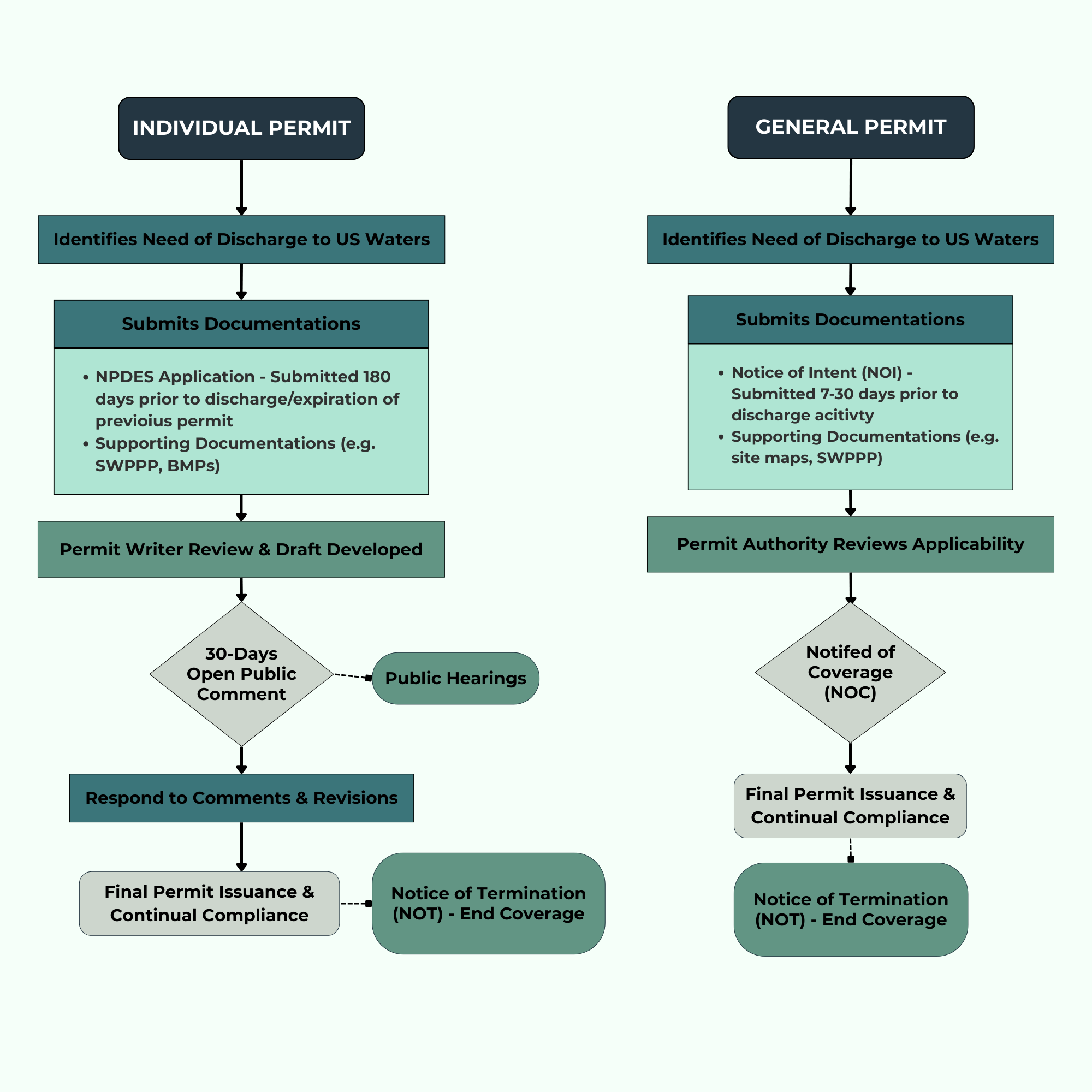
Note: If a permit is EPA-issued, additional steps may be required such as the State National Environmental Policy Act (NEPA) review or Section 401 Certification.
Despite the final issuance, the public or individuals unsatisfied with the terms have the right to appeal the process to the Environmental Appeals Board. This makes it crucial for facilities to stay in compliance with regulations and report their results periodically, usually on Discharge Monitoring Report (DMR), Stormwater Monitoring and Reporting, or Wastewater Monitoring and Reporting.
Avoiding Non-Compliance
Noncompliance with NPDES permit conditions may result in monetary fines, civil penalties, and project delays. Notice of Violations (NOVs) and enforcement from non-compliance can disrupt operations. Facilities are encouraged to seek guidance from experts such as SEC. We assist clients in understanding their surrounding environment, selecting appropriate technologies, and implementing best practices tailored to permit requirements. Our team works to streamline the application process for individual or general permit coverage, and support your facility to meet federal, state and local discharge regulations with confidence.
Two Levels of Effluent Control
To adequately protect water quality, NPDES permit limits include one or both of the following:
- Technology-Based Effluent Limitations (TBELs) – Require a minimum level of treatment for point source discharges based on performance of available technologies, as outlined in EPA regulations or determined by best professional judgement (BPJ).
- Water Quality-Based Effluent Limitations (WQBELs) – Required when TBELs alone are insufficient to meet water quality standards. These limits are tied to Total Maximum Daily Loads (TMDLs) established under Section 303(d) of the Clean Water Act.
Seeking NPDES Permitting Support?
Do not hesitate to reach out to us via the “Get a Quote” button below! Our team is ready to help you navigate the NPDES process and keep your operations running smoothly and confidently.
Serving the Southeast
NASHVILLE | CHATTANOOGA | BIRMINGHAM
Serving the Southeast
NASHVILLE | CHATTANOOGA | BIRMINGHAM
NASHVILLE
CHATTANOOGA
BIRMINGHAM