

Spill Prevention, Control, and Countermeasure (SPCC) Plan
SEC supports facilities in developing, implementing, and maintaining compliant SPCC plans under EPA regulations.
SPCC Plan Generation Guidance
& Compliance Services
What is an SPCC Plan?
The Spill Prevention, Control, and Countermeasure (SPCC) Rule, issued by the EPA under 40 CFR Part 112, outlines specific planning and prevention measures of oil spills at certain non-transportation related facilities. The regulations aim to prevent discharge of oil into navigable waters or adjoining shorelines. These plans are not submitted to the EPA but must be kept onsite and reviewed every five years or updated after any significant facility changes.
A SPCC Plan documents:
- Oil storage and handling operations
- Spill prevention and secondary containment practices
- Spill response procedures and contingency plans
- Facility drainage and discharge controls
- Personnel training, inspection schedules, and emergency response protocols
Who Needs an SPCC Plan?
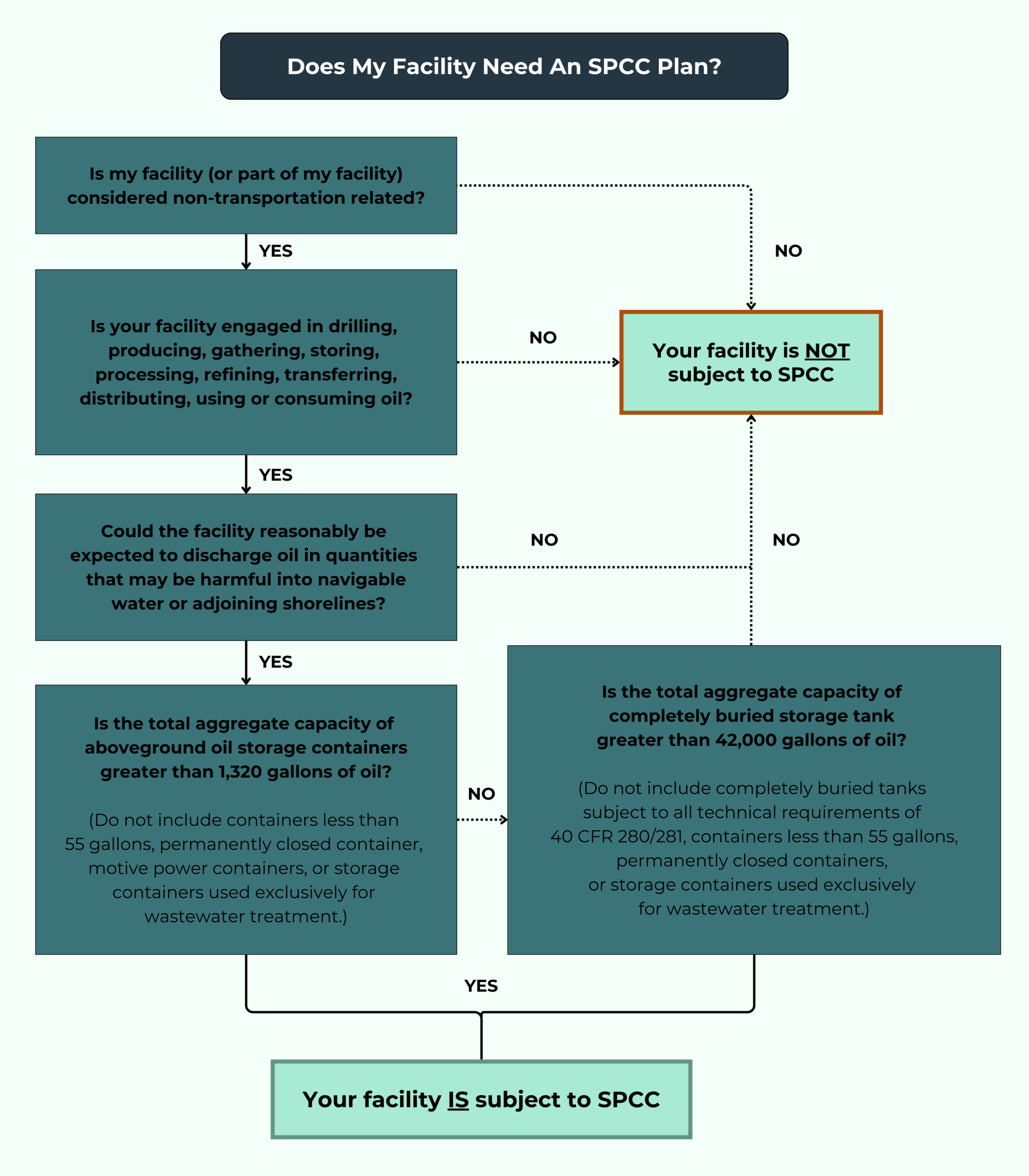
The following flowchart helps you determine whether a SPCC Plan is required for your facility:
How to Count Your Oil?
When evaluating SPCC applicability, it is crucial to understand what counts as oil and how container sizes affect your compliance status. Many facilities mistakenly exclude oil-filled equipment or non-petroleum oils when estimating their storage totals. The EPA defines oil broadly under 40 CFR 112.2 which applies to a wide variety of substances including:
- Petroleum-based products
- Vegetable oils
- Animal fats and greases
- Synthetic oils, including silicone and mineral oils
- Oil refuse or sludge
- Oils mixed with waste (excluding dredged spoil)
The general rule is that if it floats on water and causes a sheen, it likely counts as oil. Containers counted for SPCC purposes apply to those with storage capacities of 55 gallons or more. This encapsulates:
- Aboveground storage tanks (ASTs)
- Oil-filled transformers and other electrical equipment
- Oil-filled operating equipment
- Hydraulic systems
- Lubricating and coolant systems
- Portable containers like totes and drums
- Tanks in vaults or bunkered tanks
- Manufacturing equipment and processing vessels that hold oil
Oil stored in smaller quantities is not considered as part of the inventory for the SPCC plan or counted toward the 1,320 gallons threshold.
How Do I Know If My Facility Needs an SPCC Plan?
After assessing a facility’s total oil storage capacity and largest aboveground container, the appropriate plan type can be identified using the following table:
| Type | Maximum Oil Storage Capacity | Largest Aboveground Individual Container | Applicable Regulations | Certifications |
| Tier I | < 10,000 gallons | < 5,000 gallons | Template in Appendix G of 40 CFR 112 | Self-certified |
| Tier II | < 10,000 gallons | ≥ 5,000 gallons | 40 CFR 112.7 and subparts B or C | Self-certified |
| All Other Facilities | ≥ 10,000 gallons | Any Size | 40 CFR 112.7 and subparts B or C | Certified by a Professional Engineer |
Note: To qualify as Tier I or Tier II, the facility must not have had a single spill over 1,000 gallons or two spills over 42 gallons within a 12-month period into any navigable waters or adjoining shorelines.
Some states don’t accept self-certified plans. SEC advises that everyone subject to the SPCC rule, develop a SPCC plan stamped by certified professional engineers (PE) for the most accurate assessment of applicable requirements and plan type.
What Should I Do to Develop a Compliant SPCC Plan?
To begin developing your SPCC plan:
- Collect your oil inventory
- Locate all oil containers onsite (including tanks, drums, totes, oil-filled equipment, etc.)
- Calculate the sum total storage capacity of oil in containers 55 gallons or more to determine if facility exceeds the 1,320 gallon SPCC threshold
- Assess spill prevention structures, equipment, or procedures already in place
- Generate SPCC Plan
- Identify and designate personnel roles and responsibilities
- Develop spill response prevention practices and procedures
- Outline procedures for handling and disposing contained materials
- Include contingency planning and/or Facility Response Plan
- Describe countermeasures for spill discovery, response and compliance
- Certify SPCC Plan
- Self-certification is available for Tier I & II facilities (but some states do not accept them)
- SEC highly recommends plans to be reviewed and stamped by PE to ensure all federal and state-specific requirements are met
To maintain compliance, SPCC plans:
- Must be stored at a location normally attended at least 4 hours per day
- Must be reviewed every 5 years
- Must be updated if technical amendments affect the potential for a discharge or if facility’s classification changes and no longer be classified as a Tier I or Tier II facility
In addition to the SPCC Plan, facilities may be subjected to submit Facility Response Plan (FRP) to the EPA if facilities contain:
- More than 42,000 gallons of total oil storage capacity and transfer it over water to/from vessels
- More than 1 million gallons of total oil storage capacity and meets one of the following conditions:
- Do not have sufficient secondary containment for each aboveground storage area
- Located at a distance such that discharge from facility could cause harm to the environment
- Located at a distance such that discharge from facility would shut down a public drinking water intake
- Has within the past five years a reportable discharge greater than or equal to 10,000 gallons
SEC can expertly help facilities determine facility status and prepare for any necessary supporting documents, ensuring that your site meets regulations and operates smoothly.
What Are the SPCC Requirements I Need to Follow?
Different subparts of 40 CFR part 112 apply depending on your facility type:
- §112.1-7: Applies to all facilities that meet general applicable requirements
- §112.8: Applies to onshore facilities excluding production facilities (e.g. gas plants, pipeline pump/compressor stations or non-production related activities at production operation)
- §112.9: Applies to onshore oil production facilities excluding drilling and workover facilities and wet gas production facilities producing and storing liquid condensate in quantities exceeding regulatory thresholds
- §112.10: Applies to onshore oil drilling and workover facilities (e.g. onshore drilling or workover rig at gas exploration site)
- §112.11: Applies to offshore drilling, production, workover facilities (e.g. offshore gas related activities occurring landward of coastline)
For the specific breakdown of regulation details, refer to the Code of Federal Regulations Part 112 Oil Prevention.
Need Help With Developing Your SPCC Plan?
Do not hesitate to reach out to us via the “Get a Quote” button below! We are more than happy to answer all your questions and support you every step of the way.

Serving the Southeast
NASHVILLE | CHATTANOOGA | BIRMINGHAM
Serving the Southeast
NASHVILLE | CHATTANOOGA | BIRMINGHAM
NASHVILLE
CHATTANOOGA
BIRMINGHAM