

Process Safety Management (PSM) Process Hazard Analysis (PHA)
SEC provides expert support in conducting Process Hazard Analyses (PHA) to identify, evaluate, and mitigate risks associated with hazardous chemical processes, helping keep your workplace safe and your operations compliant with regulations.
Process Hazard Analysis Techniques
& Risk Assessments
What is PSM Process Hazard Analysis (PHA)?
Process Safety Management (PSM) is a regulatory framework developed by OSHA under 29 CFR 1910.119 to handle highly hazardous chemicals. This comprehensive program integrates engineering controls, management practices, and procedural systems to minimize the risk of chemical accidents. Key components of PSM standards comprise of:
-
- Organizational and Operational Procedures
- Design and Engineering Guidance
- Audit and Evaluation Protocols
- Additional Methods for Hazard Identification and Risk Mitigation
A central component of the PSM standard is the Process Hazard Analysis (PHA). PHA is a structured risk assessment tool used to identify and evaluate potential hazards associated with chemical processes. Evaluations are performed before initial design and construction, before process startup, and during major modifications or shutdowns.
Who Needs PHA?
Facilities handling highly hazardous chemicals are required to conduct a Process Hazard Analysis (PHA) if their processes are covered under OSHA’s Process Safety Management (PSM) standard. These typically include:
-
- Chemical manufacturers
- Petroleum and gas refining plants
- Industrial manufacturing facilities
- Pharmaceutical production
OSHA also mandates that PHA should be performed by a team consisting of at a minimum:
-
- Process engineer
- Experienced operator
- Qualified facilitatory.
Note: While EPA’s Risk Management Program (RMP) also requires facilities with covered chemicals to perform hazard assessments, its scope emphasizes offsite consequence analysis and emergency response coordination with local agencies, rather than worker-focused safety protocols.
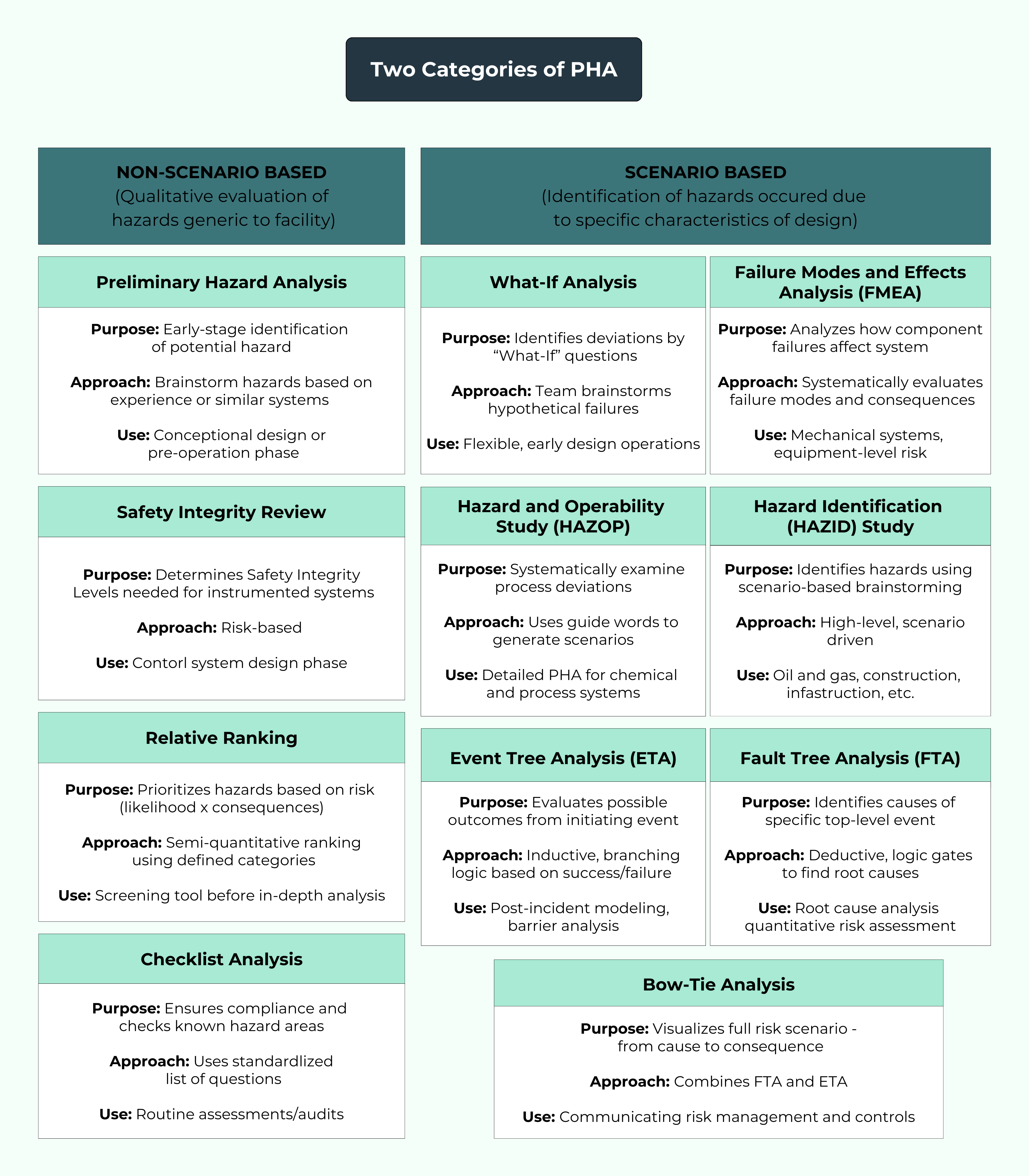
Two Categories of PHA
Process for Conducting PHA
An effective PHA process follows:
-
- Defining Scope & Objectives
- Review all modifications made to process since previous PHA
- Review previous process safety incidents
- Review status/resolution of previous PHA recommendations
- Address hazards associated with abnormal operating modes
- Ensure compliance with current PHA regulatory requirements
- Assembling a Knowledgeable Team
- Include members with expertise in engineering, operations, and safety
- Selecting Appropriate Methodology
- Select options based on process and facility risk level
- Consider Non-Scenario Based (i.e. Experience-Based) or Scenario Based (i.e. Predictive-Based)
- Identifying Hazards & Analyze Consequences
- Evaluating Safeguards & Recommend Improvements
- Documenting Findings & Implementing Follow-Up Actions
- Defining Scope & Objectives
All PHAs must be documented, reviewed, and updated on a five-year cycle as mandated under 29 CFR 1910.119.
Regulatory Compliances for PHA
The requirements for PSM classified by various steps under 29 CFR 1910.119:
-
- Initial PHA (§1910.119(e)(1)) – Conducted before facility start-up to ensure potential hazards are considered from outset or during development phase for any covered process
- Revalidation (§1910.119(e)(6)) – PHA must be updated at least once every 5 years
- Team Composition (§1910.119(e)(4)) – Multidisciplinary team with expertise in engineering, operations, and safety to ensure comprehensive review
- Documentation (§1910.119(e)(5)) – Findings, recommendations, resolutions documented, and improvements tracked until completion
Additional requirements may apply under EPA’s RMP Rule (40 CFR Part 68) for facilities managing toxic or flammable substances.
Looking to Implement or Revalidate Your PSM PHA?
Our SEC team is ready to improve your facility’s risk management practices! Do not hesitate to reach out to us via the “Get a Quote” button below.
Serving the Southeast
NASHVILLE | CHATTANOOGA | BIRMINGHAM
Serving the Southeast
NASHVILLE | CHATTANOOGA | BIRMINGHAM
NASHVILLE
CHATTANOOGA
BIRMINGHAM