

Prevention of Significant Deterioration (PSD) Permitting
SEC helps facilities navigate the complex PSD permitting process with confidence and ensures that projects meet PSD regulations. From compliance with PSD major source thresholds to Clean Air Act requirements, we support your team through every step and meet all project timelines.
PSD Permit Regulations & Processes
What is PSD Permitting?
The Prevention of Significant Deterioration (PSD) permitting program is a federal preconstruction review process required under the Clean Air Act (CAA). It applies to new or modified major stationary sources of air pollution located in areas that are in attainment or unclassifiable with respect to National Ambient Air Quality Standards (NAAQS). PSD permitting only applies to criteria pollutants regulated under NAAQS and doesn’t cover hazardous air pollutants (HAPs). Attainment is defined as air quality in a geographic area that meets or is cleaner than the national standard, while unclassifiable areas are locations where EPA has yet to determine air quality status.
Although PSD was originally developed and overseen by EPA, implementation authorities are delegated to states, local agencies, and tribes. Each authorized program must be at least as stringent as federal requirements, and many states have developed their own PSD regulations and processes that meet or exceed EPA’s standards.
The regulatory framework ensures economic development projects proceed in a manner consistent with protecting existing air quality and public health. PSD permitting does not prohibit emissions increases, but its primary responsibility and goals are to:
-
- Protect public health and welfare
- Preserve clean air in national parts, wilderness areas, and other natural spaces
- Support sustainable economic growth
- Promote careful review and transparency in permitting decisions
Important Note: The definition of “major source” under PSD may differ from thresholds that apply under the Title V Operating Permit program, so facilities must evaluate applicability carefully.
Who Needs A PSD Permit?
Permits are required for new construction projects that meet both of the following conditions:
-
- The facility is located in an area designated as attainment or unclassifiable under NAAQS, and
- The facility is either:
- A new major source of criteria air pollutants, or
- An existing major source undergoing significant modification
Common examples of projects in need of PSD permits are power plants, refineries, industrial manufacturing facilities, and expanding facilities. However, not all sources are subject to PSD regulations. Exemptions include:
-
- Emission source at nonprofit health or education institutions
- Portable stationary sources operating at a site for less than 24 months (e.g. mobile asphalt plants)
- Nonroad engines (e.g. agricultural or construction equipment)
When is PSD Review Required?
When determining if PSD review is required, the steps can become complicated quickly. A simplified summary include:
-
- Determining the facility-wide potential to emit (PTE)
- If the PTE for any New Source Review (NSR) regulated pollutant is greater than 250 tons per year (tpy), then the facility is considered a PSD major source.
- The 250 tpy threshold might be reduced to 100 tpy if the facility falls into one of the specifically defined source categories seen in 40 CFR 51.166(b)(1)(i).
- If a modification at a facility that is not a PSD major source increases emissions such that the facility’s potential to emit exceeds the major source thresholds (100 or 250 tpy), the facility becomes a new PSD major source subject to PSD permitting requirements.
- If the PTE for any New Source Review (NSR) regulated pollutant is greater than 250 tons per year (tpy), then the facility is considered a PSD major source.
- Calculating the baseline emissions (i.e. “Actual Emissions”)
- Calculating your future emissions (loosely considered “Potential Emissions”)
- Potential emissions can be based on a full production schedule at full capacity or more realistic emission level, calculated using more realistic schedule or production values (i.e. projected actual emissions).
- Note that these values can show up as limits in future permits.
- Comparing the past actual emissions with future emissions
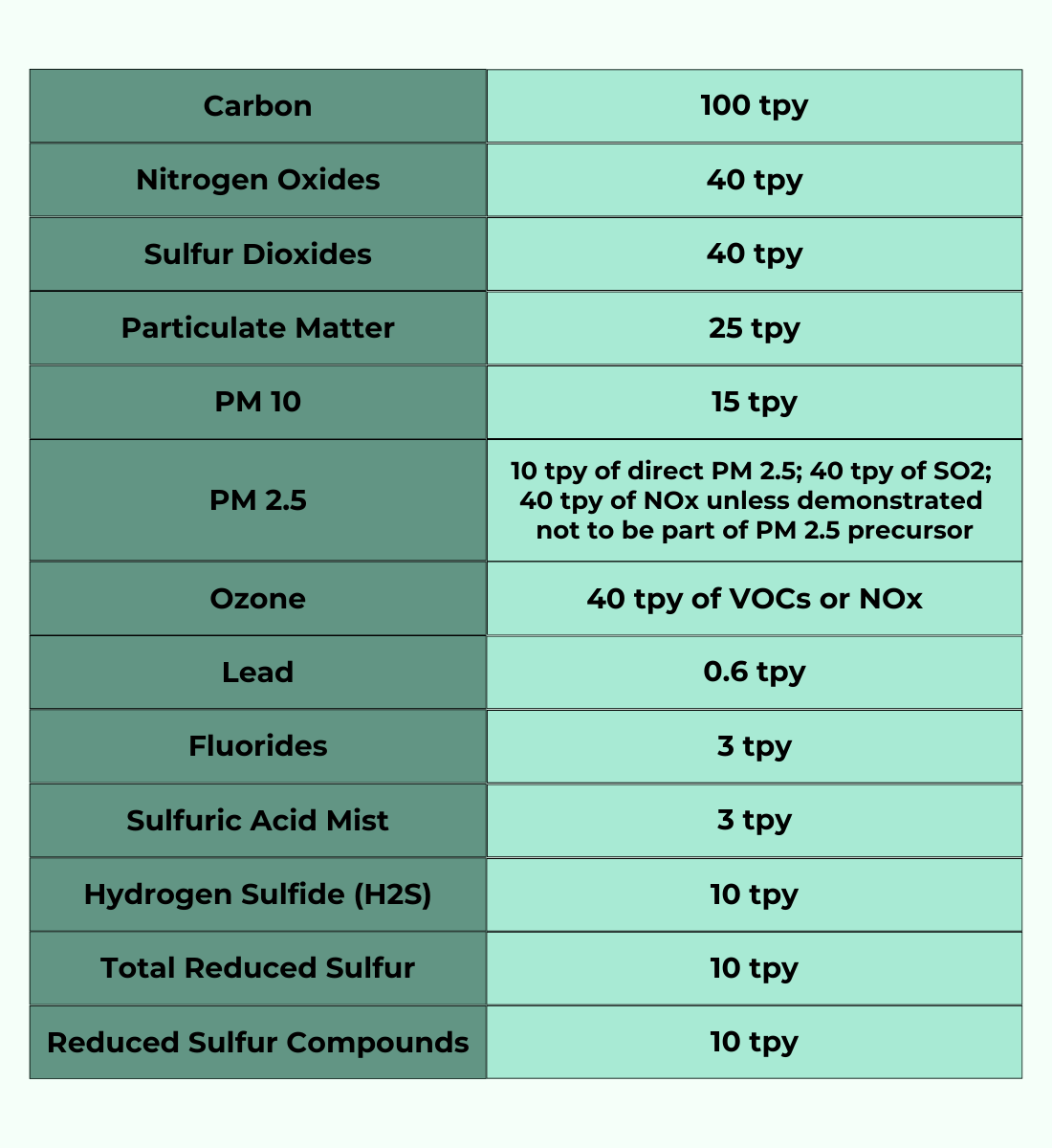
- If the increase in each pollutant is less than the significant threshold identified below, then no PSD review will be required.
- If the increase in any one pollutant exceeds the significant thresholds, then the facility or modification may be subject to PSD review.
- Note that contemporaneous increases/decreases may have to be considered in this analysis (usually any that have occurred over the 5-year period previous to the application).
- NSR Significance thresholds 40 CFR 51.166(b)(23):
- Determining the facility-wide potential to emit (PTE)
PSD Permitting Process
The PSD permitting process follows:
-
- Pre-Application Coordination – Initial meeting to identify need for PSD permit and conduct preliminary Best Available Control Technology (BACT) analysis and air quality modeling.
- Permit Application Preparation – Compile technical documentation and complete required application forms.
- Permit Application Submission – Submit application and undergo review.
- Completeness Review – Usually takes around 30 to 60 days.
- Technical Review – Detailed evaluation of BACT, modeling, and analysis. Usually takes several months.
- Draft Permit & Public Notice – Occurs once application is complete and draft permit is published. EPA reviews and comments, usually 2 weeks prior to public comment period.
- Public Comment Period – A 30 to 60 days open period where public and stakeholder feedback are allowed.
- SEC has the expertise and experience to guide facilities that are seeking to avoid PSD review. This is through “project accounting,” which takes into account both increases and decreases associated with a project and through “netting,” which takes into account increases and decreases from other projects that are contemporaneous with the particular change.
- Final Permit Decision – Responding to public comments before issuance of final permit.
- Post-Permit Monitoring – Compliance assurance through recordkeeping, monitoring, and reporting.
Key Requirements for PSD Applications
The key requirements for a PSD application include:
-
- Best Available Control Technology (BACT) – Applicants must implement BACT for each regulated pollutant where control level is determined case-by-case.
- Air Quality Modeling – Facilities must conduct dispersion modeling to show that projected emissions do not violate NAAQS and stay within the applicable PSD increments.
- Additional Impact Analysis – Applicants must assess visibility impacts, effects on soils and vegetation, and impact on air quality values in nearby areas.
- Public Involvement – The inclusion of the public opinion and feedback is crucial towards permit approval.
PSD Regulations & Compliance Obligations
After the issuance of PSD permits, facilities must continue to comply with regulations. This includes detailed recordkeeping and recording of emissions, submitting periodic compliance reports, and monitoring through technology such as continuous emissions monitoring system (CEMS).
Implications of PSD Permits
-
- For any PSD major source, every change (big or small) must be assessed for PSD applicability.
- For projects that require PSD review, a PSD permit must be obtained prior to starting any construction or equipment installation.
- Emissions controls might be required as part of the review process.
- Facilities may choose to install controls to legally avoid PSD review
- These controls will become federally enforceable permit conditions/limits that would apply for the life of the facility
- Federal EPA would have to review and approve all permits and permit changes.
- The cost of installing BACT emissions control devices could be very expensive.
Risks of Non-Compliance
Common challenges faced with applying for or maintaining PSD permits include insufficient BACT evaluations, lack of public engagement, and underestimating timeline or complexity. Violations of PSD permit conditions can result in exceeding emission limits, operating without required technologies, or failing to submit required reports. This could lead to penalties such as:
-
- Administrative fines (up to $37,500/day per violation)
- Civil/criminal penalties (up to $500,000/day for organizations)
- Permit revocation
Staying Ahead of PSD Permitting
Ongoing PSD compliance is critical to keeping development projects on track, avoiding costly setbacks, and protecting environmental integrity. SEC offers expert full-service support for facilities navigating PSD permits. We support clients at every step, whether it is determining applicability, coordinating regulatory agencies, or conducting BACT evaluations.
Need Support with PSD Permitting?
SEC is ready to help, so please do not hesitate to reach out via the “Get a Quote” button below! We are more than happy to help provide expert PSD permitting guidance to ensure
your projects stay compliant, avoid costly delays, and meet all requirements
under the Clean Air Act and PSD regulations.
Serving the Southeast
NASHVILLE | CHATTANOOGA | BIRMINGHAM
Serving the Southeast
NASHVILLE | CHATTANOOGA | BIRMINGHAM
NASHVILLE
CHATTANOOGA
BIRMINGHAM