

Multi-Sector General Permit (MSGP)
SEC helps industrial facilities determine their Multi-Sector General Permit (MSGP) applicability and develop necessary compliant documentation, such as Stormwater Pollution Prevention Plans (SWPPP) and visual assessment, to maintain full stormwater compliance under the state’s regulations.
MSGP Regulatory Compliance & Updates
What is MSGP?
The Multi-Sector General Permit (MSGP) is a federal permit under the National Pollutant Discharge Elimination System (NPDES) program that authorizes the discharge of stormwater associated with industrial activities. Issued by the US Environmental Protection Agency (EPA), the MSGP applies only to states, territories, or tribal lands where EPA is the NPDES permitting authority. These areas include:
-
- Four states: Massachusetts, New Hampshire, New Mexico, and Idaho
- The District of Columbia
- Puerto Rico
- All U.S. territories except for the Virgin Islands
- Federally operated facilities in Colorado, Delaware, Vermont, and Washington
- Most Indian country lands
- Other designated activities in specific states (e.g., oil and gas activities in Texas and Oklahoma)
States such as Tennessee manage their own industrial stormwater permits under state authority. Refer to SEC’s TMSP page to learn about the details of Tennessee general permits. In general, to comply with general permits, facilities must implement a Stormwater Pollution Prevention Plan (SWPPP), train employees, submit Notice of Intent (NOI), conduct quarterly visual assessments/inspections, and more.
Who Needs MSGP Coverage?
The MSGP coverage is required for facilities that discharge stormwater associated with regulated activities. These facilities typically fall under one or more of the 30 defined sectors, each categorized by Standard Industrial Classification (SIC) codes. These sectors determine industry-specific benchmark monitoring parameters, control measures (e.g. Best Management Practices), and applicability of federal effluent limitation guidelines.
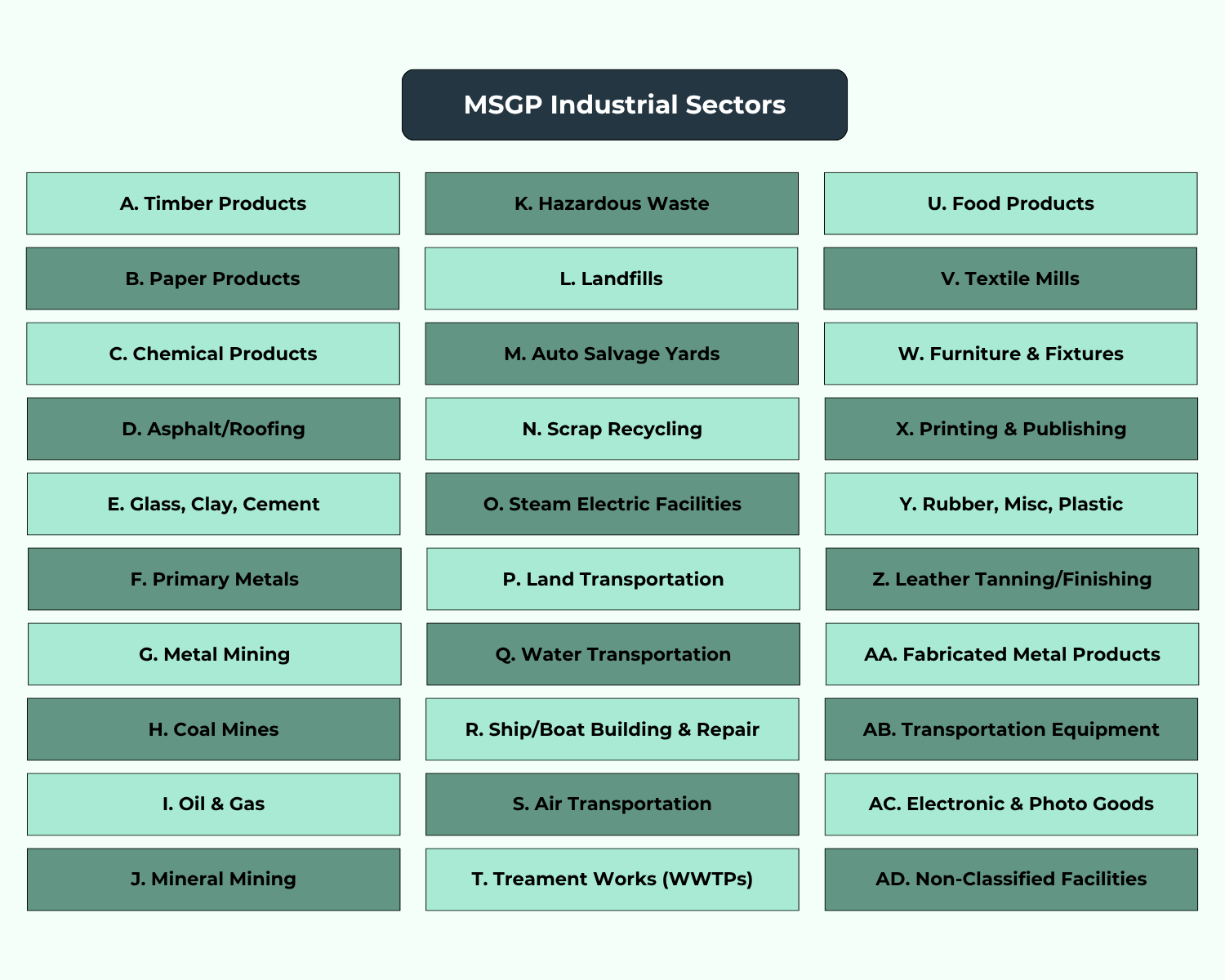
Refer to the EPA webpage for the detailed breakdown of each sector’s limitations and compliances.
MSGP Compliance Process
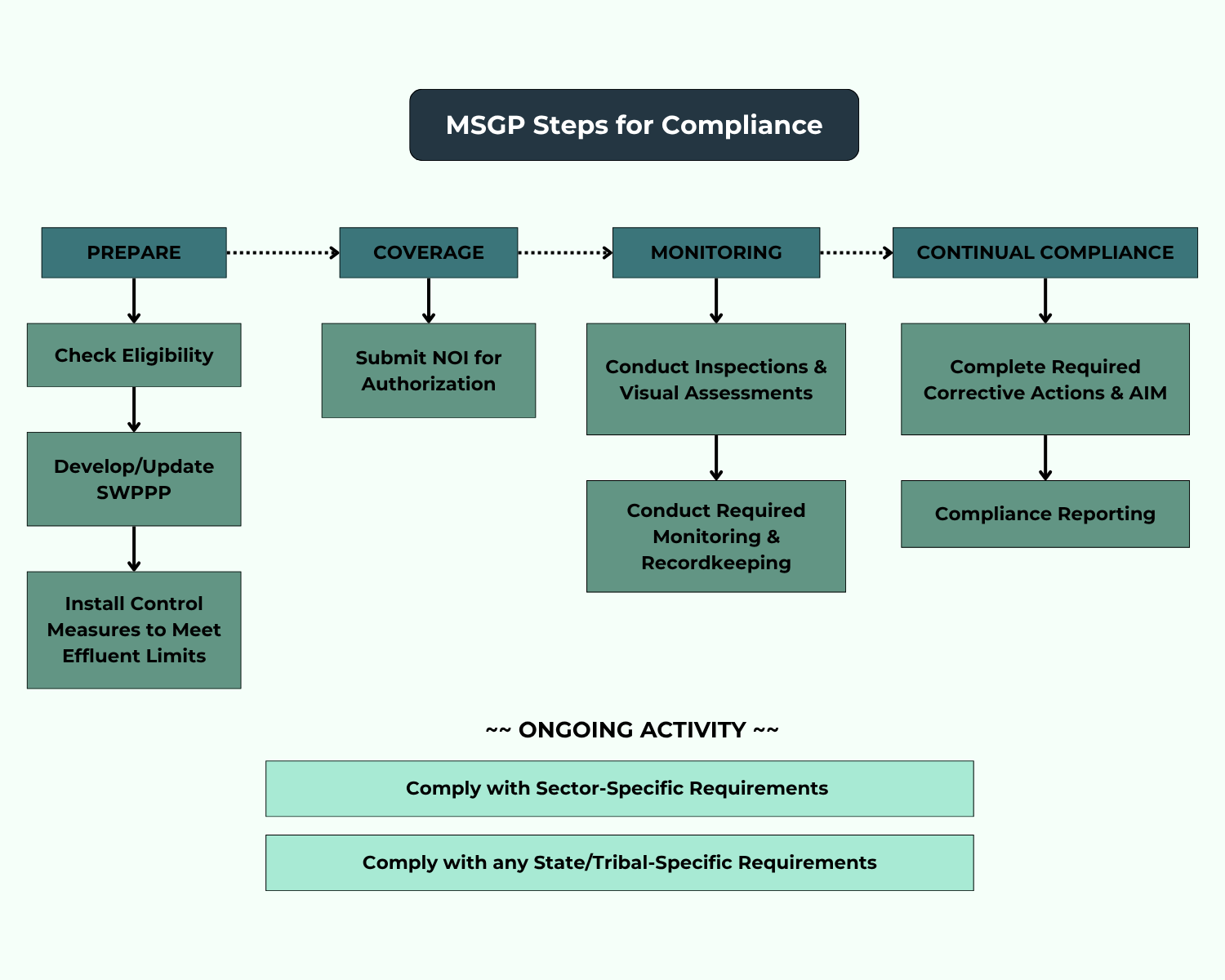
Navigating the MSGP process involves a step-by-step approach, with the general outline:
-
- Determine Applicability
- Gathering Necessary Documentations & Developing SWPPP
- Training Frequency At Least Annually
- More Frequent Training Required:
- High Employee Turnover
- Complex or Multiple Sectors of Stormwater Programs
- Significant Regulation Changes
- New Hazard, Equipment, or Process Introduced
- Submitting Notice of Intent (NOI)
- Conduct Inspections & Monitoring
- Quarterly Visual Assessments
- Benchmark Monitoring
- Effluent Limitation Guidelines (ELG)
- Impaired Water Monitoring, where applicable
- Implement Corrective Actions As Necessary
- Submit Reports & Records
- Submit Notice of Termination (NOT)
The flowchart below details the steps towards MSGP application and compliance:
2026 MSGP Proposed Changes
The EPA has released its proposed 2026 MSGP, expected to take effect in February 2026. This version introduces a range of new compliance expectations and monitoring expansions. The key changes include:
-
- Enhancement of Stormwater Control Measures (SCMs)
- Removing the word “temporarily” to indicate EPA’s perspective that “it is generally best practice to implement stormwater control measures on more regular basis”
- Evaluate facility’s exposure to major storm and flood events based on current conditions (defined as “100-year flood”)
- Etc.
- Effluent Limitations
- Removes vague requirement to “control discharges as necessary to meet applicable standards”
- Etc.
- Monitoring Enhancements
- New provisions requiring majority of sectors to conduct “report-only” indicator analytical monitoring for Per- and Polyfluoroalkyl Substances (PFAS)
- Proposing shift of certain sectors from “report-only” indicator monitoring to benchmark monitoring for pH, total suspended solids (TSS), and chemical oxygen demand (COD)
- Etc.
- Additional Implementation Measures (AIM)
- Add to current AIM Level 1 response requirements the inspection of benchmark exceedance
- The three-tiered response system: Level 1 (Review SWPPP & Control Measures), Level 2 (Implement Enhanced Housekeeping & Pollution Prevention), Level 3 (Install Structural or Infiltration-Based Controls)
- Etc.
- Add to current AIM Level 1 response requirements the inspection of benchmark exceedance
- Enhancement of Stormwater Control Measures (SCMs)
For the complete 2026 EPA proposal, head over to the released 2026 MSGPT Fact Sheet Draft.
Staying Ahead of MSGP
Each facility is compliant to distinct regulations and permitting requirements. With major changes arriving in the 2026 MSGP, it is critical for facilities to evaluate their current compliance and plan ahead. Whether you’re renewing an existing permit or applying for the first time, our SEC team is here to help!
Need Support with MSGP?
Do not hesitate to reach out to us via the “Get a Quote” button below! Our SEC is more than happy to assist you and provide clarifying information to ensure success in your permitting process.
Serving the Southeast
NASHVILLE | CHATTANOOGA | BIRMINGHAM
Serving the Southeast
NASHVILLE | CHATTANOOGA | BIRMINGHAM
NASHVILLE
CHATTANOOGA
BIRMINGHAM