
Hazardous Waste Annual Report
SEC provides expert guidance in preparing and submitting hazardous waste reports, helping facilities meet all state and federal compliance obligations under the Resource Conservation and Recovery Act (RCRA).
Hazardous Waste Reporting
Compliance & Management
What is Hazardous Waste Reporting?
As part of the U.S. Environmental Protection Agency’s (EPA) mission to protect human health and the environment, the generation, management, and disposal of hazardous waste are regulated under the Resource Conservation and Recovery Act (RCRA). This “cradle-to-grave” system tracks hazardous waste from its point of generation through treatment, storage, and final disposal. Under RCRA, Large Quantity Generators (LQGs) are required to submit Biennial Reports to the EPA during even-numbered years, documenting data collected from the collection (odd-numbered) year. Some states impose more stringent requirements, mandating annual reporting and extending reporting obligations to Small Quantity Generators (SQGs) and Very Small Quantity Generators (VSQGs) as well.
Who Needs to Submit a Hazardous Waste Report?
Hazardous waste reporting requirements vary based upon state. Under the federal 40 CFR 262.41 regulation, all Large Quantity Generators (LQGs) are required to submit biennial reports to the Environmental Protection Agency (EPA) and potential annual reports to their state agency. This includes any facility that meets any of the following criteria:
-
- Generates more than 1,000 kg (2,200 lbs) of hazardous waste in any calendar month
- Accumulated more than 1 kg (2.2 lbs) of acute hazardous waste in a calendar month
- Generated more than 100 kg (220 lbs) of spill cleanup materials contaminated with acute hazardous waste
- Generated more than 15 tons of hazardous waste or wastewater in a calendar year
Some states also require Small Quantity Generators (SQGs) and Very Small Quantity Generators (VSQGs) to submit annual hazardous waste reports. Refer to SEC’s Generator Status page to determine the classification of your facility.
What to Include in Hazardous Waste Reports?
Whether filing federal or state agency hazardous waste reports, generators must be prepared to provide:
-
- Quantity and characteristics of hazardous waste generated
- Hazardous waste manifest forms and previous reports
- Documentation of on-site accumulation or generation
- Results of laboratory analysis of waste
- Contracts or agreements with off-site facilities managing your wastes
- Copies of permits for on-site waste management systems
EPA Biennial Report Regulations
The EPA Biennial Hazardous Waste Report (EPA Form 8700-13A/B) must be submitted every even-numbered year by March 1 for all Large Quantity Generators (LQGs). As regulated in 40 CFR Part 262.41(a), the report includes:
-
- EPA identification (ID) number
- Name and address of facility
- Quantity of hazardous waste sent to each treatment, storage and disposal facility (TSDF)
- Description of how the waste was managed on-site or off-site during reporting period
State Hazardous Waste Regulations
Each state has its own set of regulations regarding the submission of Hazardous Waste Reports. For instance, Tennessee requires annual hazardous waste reports for Small Quantity Generators (SQGs) alongside Large Quantity Generators (LQGs) and encourages Very Small Quantity Generators (VSQGs) to also report. In states that mandate Hazardous Waste Reports, facilities are generally required to submit the full set of RCRA Subtitle C reporting forms, which includes:
-
- Site Identification (ID) Form – EPA Form 8700-12
- Waste Generation and Management (GM) Form
- Waste Received (WR) from Off-Site Form
- Off-site Identification (OI) Form
The following table lists the states that require annual reporting:
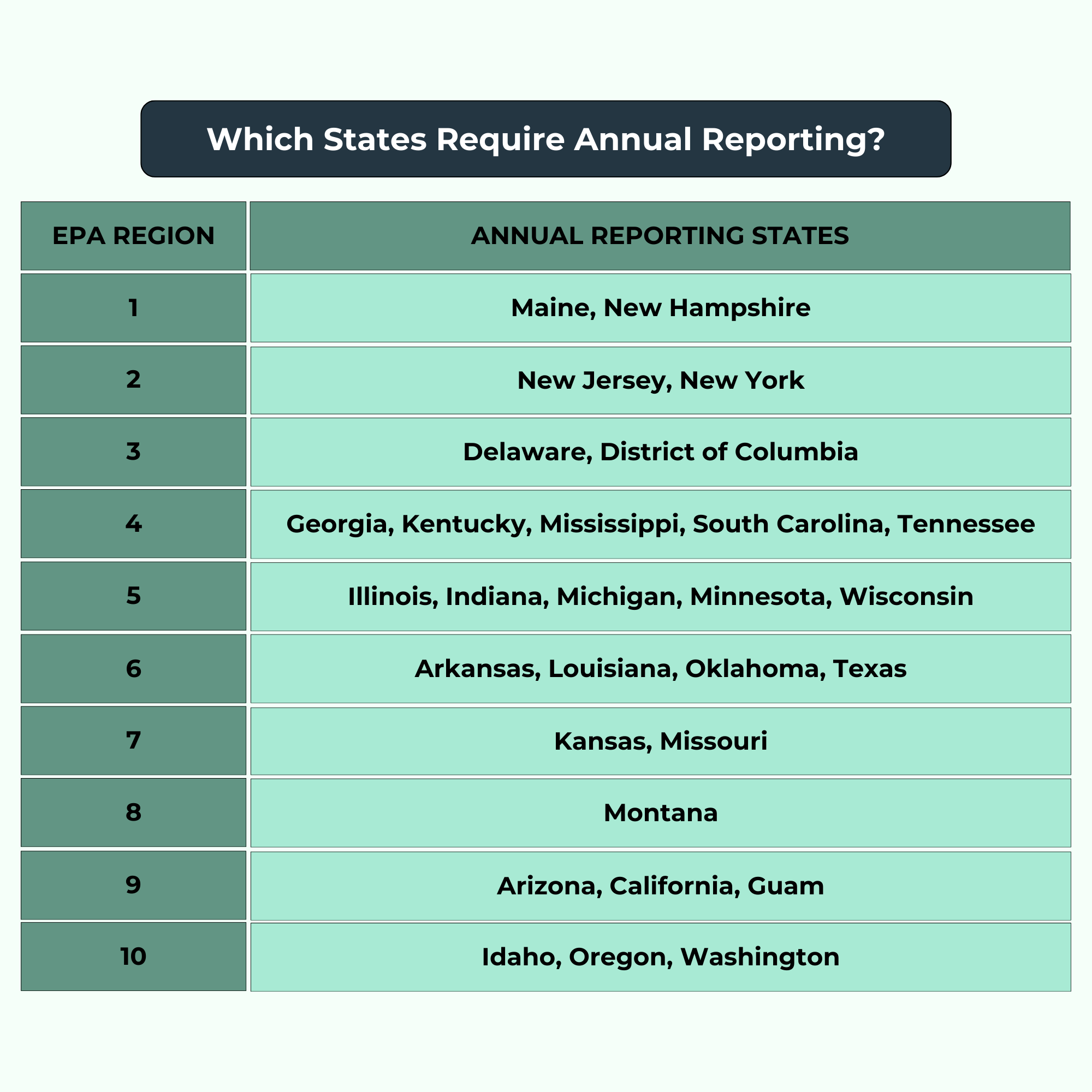
Some states require their own annual hazardous waste reporting in addition to the federal biennial cycle. In these states, generators typically submit the Biennial RCRA HW Report in even-numbered years while submitting the Annual HW Report in the odd-numbered years. Many states use the same or similar reporting forms for both reporting cycles (refer to each state’s site for specific deadlines and details). The reporting framework is as follows:
-
- States authorized by EPA to administer the RCRA program (Refer to SEC’s RCRA page for detailed list)
- Submit hazardous waste report to state, which forwards data to EPA
- States not authorized
- Submit directly to EPA via RCRAInfo
- States authorized by EPA to administer the RCRA program (Refer to SEC’s RCRA page for detailed list)
Staying Ahead of Hazardous Waste Reports
Due to the complexity of overlapping federal and state regulations, the SEC recommends facilities work with experts for accurate hazardous waste reporting and compliance. Our SEC team is eager to support you through annual/biennial reports, identifying generator status, and assisting with preparing all necessary documentation.
Need Support with Your Hazardous Waste Report?
Reach out to us via the “Get a Quote” button below! Our SEC team is ready to streamline your waste management process and support full regulatory compliance.
Serving the Southeast
NASHVILLE | CHATTANOOGA | BIRMINGHAM
Serving the Southeast
NASHVILLE | CHATTANOOGA | BIRMINGHAM
NASHVILLE
CHATTANOOGA
BIRMINGHAM