
Resource Conservation and Recovery Act (RCRA) Permitting
SEC offers full-service support for hazardous waste compliance under the Resource Conservation and Recovery Act (RCRA), streamlining your permitting and compliance process.
RCRA Classifications, Permitting, & Compliance
What is the Resource Conservation and Recovery Act (RCRA)?
The Resource Conservation and Recovery Act (RCRA) is the primary federal law governing the management of solid and hazardous waste. Administered by the US Environmental Protection Agency (EPA), RCRA establishes a “cradle-to-grave” tracking system – from point of generation to final disposal – to protect human health and the environment. The regulatory framework for waste classification, management standards, and permitting procedures are implemented through 40 CFR Parts 239-282.
RCRA Subtitle Divisions
The RCRA framework is organized into several subtitles that define the scope and responsibilities for managing different types of waste:
-
- Subtitle C – Hazardous Waste Management
- Applies to and regulates hazardous waste generators and treatment, storage, disposal facilities (TSDFs)
- TSDFs must obtain RCRA permits and comply with more stringent operational, safety, and reporting standards
- Subtitle D – Non-Hazardous Waste Management
- Regulates management of municipal and nonhazardous industrial waste
- Does not require federal permits but may be governed by state or local permitting programs
- Focuses on preventing open dumping and ensuring proper landfill design/closure care
- Other RCRA Provisions:
- Subtitle A – General Provisions
- Subtitle B – Office of Solid Waste, Authorities of Administrator and Interagency Coordinating Committee
- Subtitle E – Duties of Secretary of Commerce in Resource and Recovery
- Subtitle F – Federal Responsibilities
- Subtitle G – Miscellaneous Provisions
- Subtitle H – Research, Development, Demonstration and Information
- Subtitle I – Regulation of Underground Storage Tanks
- Subtitle J – Standards for Tracking and Management of Medical Waste
- Subtitle C – Hazardous Waste Management
Who Needs a RCRA Permit?
RCRA permits are required for any facility that treats, stores, or disposes of any hazardous waste identified or listed in 40 CFR Part 26 before construction and operation. Permits are valid for 10 years with renewal submissions 6 months before expiration. Most states are authorized by the EPA to administer hazardous waste permitting programs. Refer to the RCRA authorization list for details of permitting authority.
RCRA Permitting Process
The general RCRA permitting process follows:
-
- Pre-Application Meeting with the Public
- Submission of Application (180 days before physical construction)
- Part A –General facility activity and site information
- Part B – More detailed narrative describing operations, design, closure plans, and compliance strategies
- Permitting Agency Reviews Application
- Potential issuance of Notice of Deficiency (NOD) if revisions are required
- Agency drafts permit for public review
- Public Comment Period (45-day open public comment period)
- Final Decision Issued
- Post-Permit Responsibilities
- Permit Modifications
- Permit Appeals (if rejected)
- Permit Renewals (every 10 years)
- Permit Terminations
RCRA Waste Classification
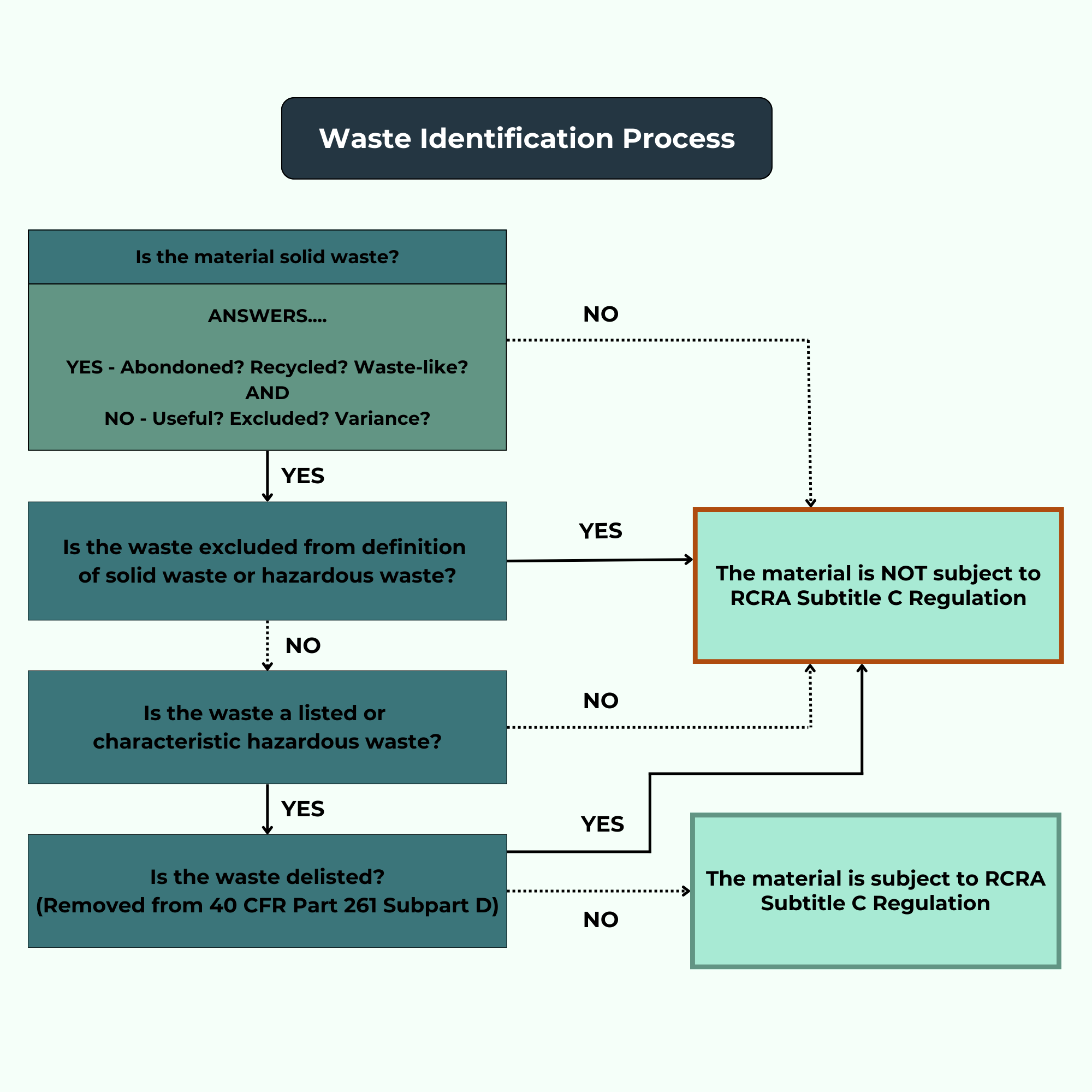
Proper waste classification is the first step in determining RCRA regulatory requirements. The process begins with evaluating whether a material qualifies as solid waste under 40 CFR 261.2.
-
- Solid Wastes – Any discarded material in form of solid, semi-solid, liquid, and even contained gaseous material
- Abandoned materials
- Recycled materials
- Inherently waste-like materials (F020-F023, F026, F028)
- Exceptions – Materials used/reused as ingredients in industrial processes, effective substitutes for commercial products, or returned to original process
- Hazardous Waste – A solid waste becomes hazardous if it meets one or more of the following criteria:
- Characteristic Waste (D Codes)
- Ignitability (D001)
- Corrosivity (D002)
- Reactivity (D003)
- Toxicity (D004-D043)
- Non-specified Sources (F Codes)
- Acute Hazardous Waste (P Codes)
- Toxic (Non-Acute) Hazardous Waste (U Codes)
- Specified Sources (K Codes) For the full breakdown on waste codes, refer to the EPA nationally defined values. The following flowchart helps with visualization of general waste identification process:
- Characteristic Waste (D Codes)
- Solid Wastes – Any discarded material in form of solid, semi-solid, liquid, and even contained gaseous material
Staying Ahead of RCRA Compliance
RCRA compliance involves navigating complex waste classifications and federal/state regulations. Violations can result in fines up to $80,000 per day per violation. Our SEC experts offer expert guidance to help prepare complete RCRA Part A and B applications, support with site inspections, and ongoing compliance.
Seeking RCRA Permit Support?
Our SEC is more than happy to assist you in RCRA classifications, permitting, and ensure you follow the necessary compliances. Do not hesitate that reach out to us via the “Get a Quote” button below!
Serving the Southeast
NASHVILLE | CHATTANOOGA | BIRMINGHAM
Serving the Southeast
NASHVILLE | CHATTANOOGA | BIRMINGHAM
NASHVILLE
CHATTANOOGA
BIRMINGHAM