
Plan Your Compliance in 2026

Understanding the regulatory due dates that apply to your facility each year is essential for keeping track of all your compliance tasks and meeting deadlines. Whether you are a new EHS manager or have decades of experience, a compliance calendar serves as an easy way to keep track of all the compliance tasks that are required and their due dates. Below we have listed a compliance calendar for several states, divided into categories: Air, Water, Waste, and Additional Compliance Reporting. The following states are covered:
- Tennessee
- Kentucky
- Georgia
- Alabama
- Noth Carolina
- South Carolina
- Mississippi
Note: Please note that the list below highlights main compliance deadlines. Please conduct a detailed review of all issued permits and regulatory requirements to ensure that all compliance tasks and appropriate due dates are represented for your specific facility.
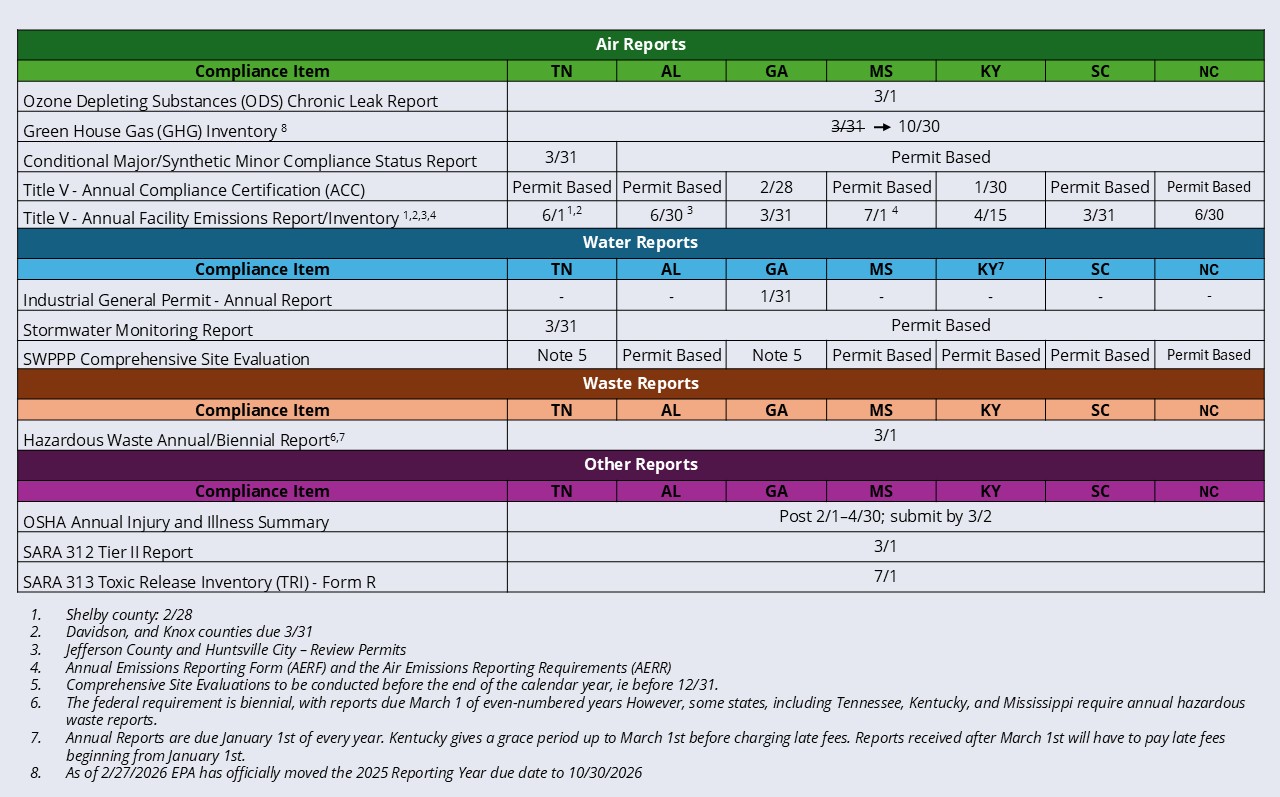
Water Reports
Industrial General Permit – Annual Report
- Purpose: Summarizes stormwater monitoring results, inspections, corrective actions, and SWPPP implementation under an industrial stormwater general permit.
- Applicability: Facilities covered under an industrial stormwater general permit (e.g., manufacturing, transportation, certain warehouses) rather than an individual NPDES permit.
- Trigger/timing: Annual, with the specific submittal window defined in the general permit (often tied to the monitoring year or coverage anniversary).
- Key content: Sampling results, benchmark comparisons, exceedances, corrective actions, site changes, and certification of SWPPP implementation.
- Purpose: Reports analytical stormwater sampling results and visual assessments required by the stormwater permit.
- Applicability: Facilities with industrial stormwater coverage that have benchmark, effluent limit, or other monitoring requirements.
- Trigger/timing: Event‑ and period‑based—e.g., a set number of qualifying storm events per year, with reporting at defined intervals or in conjunction with the annual report.
- Key content: Sample dates, locations, rainfall information, analytical results, benchmark/limit comparisons, and any follow‑up actions.
SWPPP Comprehensive Site Evaluation
- Purpose: A structured review of the facility and SWPPP to verify that BMPs are adequate and implemented, and to identify needed updates.
- Applicability: Industrial stormwater‑permitted facilities; required by most industrial general permits.
- Trigger/timing: Typically annual (sometimes more frequent) as specified in the permit; documentation is often kept on‑site and summarized in annual reporting rather than submitted separately.
- Key content: Inspection findings, BMP effectiveness, evidence of spills or illicit discharges, needed SWPPP revisions, and corrective actions.
Waste Reports
Hazardous Waste Annual/Biennial Report
- Purpose: Summarizes hazardous waste generation, management, and off‑site shipments for large quantity generators (LQGs) and, in some states, certain small quantity generators (SQGs).
- Applicability: Federally, LQGs must submit a biennial report; some states require annual reports or extend reporting to additional generator categories.
- Trigger/timing: Reporting frequency (annual vs. biennial) and exact submittal window are set by state and federal RCRA rules; it always covers a defined reporting year.
- Key content: Waste streams (waste codes), quantities generated and shipped, treatment/disposal methods, receiving facilities, and generator identification information.
Other Reports
OSHA Annual Injury and Illness Summary (Form 300A)
- Purpose: Summarizes recordable work‑related injuries and illnesses for the prior year and makes them visible to employees.
- Applicability: Most establishments with 10+ employees in non‑exempt industries; many industrial Title V facilities fall into this category.
- Trigger/timing: Annual preparation and posting for a defined period; some establishments must also submit data electronically to OSHA.
- Key content: Total cases, days away/restricted, injury/illness types, average number of employees, hours worked, and a certification by a company executive.
SARA 312 Tier II Report
- Purpose: Reports hazardous chemicals present above threshold quantities at a facility to state and local emergency planners and responders.
- Applicability: Facilities that store hazardous chemicals (as defined under OSHA HazCom) above EPCRA threshold quantities; this includes many industrial sites with fuels, process chemicals, or large inventories.
- Trigger/timing: Annual, covering maximum and average quantities on‑site during the prior year; submittal is to the SERC/EPCRA state portal, LEPC, and fire department, as applicable.
- Key content: Chemical identity, hazard categories, storage locations, maximum/average amounts, and contact information.
SARA 313 Toxic Release Inventory (TRI) – Form R
- Purpose: Reports releases and waste management of listed toxic chemicals to air, water, and land, plus recycling, treatment, and energy recovery.
- Applicability: Facilities in covered NAICS codes that exceed both employee and chemical activity thresholds (manufacture, process, or otherwise use) for listed TRI chemicals.
- Trigger/timing: Annual, for each listed chemical that exceeds thresholds, covering the prior calendar year.
- Key content: Quantities released to each medium, off‑site transfers, source reduction activities, and calculation methods.
Air Reports
Ozone Depleting Substances (ODS) Chronic Leak Report
- Purpose: Documents significant or chronic refrigerant/ODS leaks and the facility’s repair/response actions.
- Applicability: Facilities with refrigeration, AC, or process equipment using regulated ODS or HFCs above certain charge thresholds; often tied to EPA’s refrigerant management rules and any state analogs.
- Trigger/timing: Reporting is generally event‑based—required when leak rates exceed regulatory thresholds or when chronic leaks are not repaired within required timeframes.
- Key content: Equipment ID, charge size, leak rate calculations, repair attempts, verification tests, and any retrofit/retirement plans.
Greenhouse Gas (GHG) Inventory
- Purpose: Quantifies facility‑wide GHG emissions (CO₂, CH₄, N₂O, etc.) for regulatory reporting and internal management.
- Applicability: Only certain source categories and facilities that exceed GHG mass or CO₂e thresholds under the federal GHG Reporting Program (40 CFR Part 98) or state programs; not every Title V facility is automatically subject.
- Trigger/timing: Typically annual for facilities subject to GHG reporting, covering emissions from the prior year; some facilities maintain an internal GHG inventory even if not required, to support ESG or corporate reporting.
- Key content: Fuel use, process emissions, calculation methods, emission factors, and QA/QC documentation.
Conditional Major/Synthetic Minor Compliance Status Report
- Purpose: Demonstrates that a facility with potential emissions above major‑source thresholds has actually operated below those thresholds by complying with enforceable limits (e.g., fuel caps, hours, throughput).
- Applicability: Facilities operating under conditional major or synthetic minor permits in lieu of full Title V; state‑specific terminology and formats, but the concept is consistent.
- Trigger/timing: Usually periodic (often annual) and explicitly defined in the state permit—“submit a compliance certification/status report” for the prior period.
- Key content: Actual emissions or surrogate parameters (fuel use, hours, production), comparison to permit limits, deviations, and corrective actions.
Title V – Annual Compliance Certification (ACC)
- Purpose: Formal certification by a responsible official that the facility complied (or did not comply) with each applicable requirement in the Title V permit over the reporting period.
- Applicability: All Title V major sources; sometimes also required for certain synthetic minors with Title V‑like permits.
- Trigger/timing: Annual (or occasionally more frequent) as specified in the Title V permit and state rules; timing is permit‑driven, not necessarily the same across states.
- Key content: List of applicable requirements, compliance status for each, monitoring/recordkeeping methods, periods of noncompliance, and a signed certification statement.
Title V – Annual Facility Emissions Report/Inventory
- Purpose: Provides a detailed emissions inventory (criteria pollutants, HAPs, sometimes GHGs) for the facility, often used to support fees, planning, and SIP obligations.
- Applicability: Most Title V sources and many synthetic minors; some states require inventories from smaller sources as well.
- Trigger/timing: Typically annual for the prior calendar year, but exact submittal timing and whether all pollutants are required can vary by state and permit.
- Key content: Emissions by unit and pollutant, operating hours, throughput, control efficiencies, calculation methods, and emission factors.