

ISO 14001 Consulting & Support Services
SEC provides expert ISO consulting services to help organizations implement and maintain environmental management systems that meet ISO 14001 standards. Our streamlined approach guides your team through the full process from internal audits to ISO certification process, ensuring complete ISO conformance and operational efficiency.
ISO 14001 Certification & Environmental Management System (EMS)
Understanding the Purpose & Significance of ISO 14001
ISO 14001 is an internationally recognized standard that provides a framework for organizations to design, implement, and continuously improve environmental management systems (EMS). EMS refers to a set of processes and practices that supports a more holistic and controlled approach towards identifying, managing, and monitoring environmental issues. This encompasses key aspects such as efficient resources usage, waste management, and achievement of certain environmental objectives.
With growing awareness of global challenges such as climate change, resource depletion, and biodiversity loss, ISO 14001 offers businesses a proactive and structured approach to address these pressing concerns. In short, adopting ISO 14001 serves as a testament to the organization’s dedication towards a sustainable future, blending environmental responsibility with strategic business growth.
Who Needs ISO 14001
ISO 14001 is suitable for organizations of all sizes and across all sectors that aim to reduce their environmental impact, ensure regulatory conformance, and demonstrate commitment to sustainability. Although accredited certification to ISO 14001 is not mandatory, many organizations pursue third party certification as a stamp of confidence that their EMS meets international standards.
ISO 14001 also adds value to organizations seeking a systematic approach to improving environmental performance in sectors such as:
- Manufacturing, production, process industries
- Energy, utilities, extractives sectors
- Agriculture, fishing, forestry, food producers
- Construction & building firms
- Transport, distribution, logistics services
- Healthcare, hospitality, recreation, other service industries
- Public sector entities and government agencies
Benefits of ISO 14001
Implementing ISO 14001 offers significant advantages, with organizations reporting measurable improvements across environmental, operational, and business performance, including:
- Demonstrating conformance with current and future statutory and regulatory requirements with greater accuracy
- Increased leadership involvement and employee engagement
- Enhanced company reputation, stakeholder confidence, and customer loyalty
- Achievement of strategic business objectives
- Cost savings through resource optimization and efficiency
- Access to new markets and expand business opportunities
- Stronger risk management and mitigation of potential liabilities
- Operational excellence and increased productivity
- Minimization of environmental footprint and promotion of better environmental performance across the supply chain
Key Actions for ISO 14001 Conformance
Achieving and maintaining ISO 14001 conformance requires a structured roadmap to ensure effective implementation of an EMS. The following step-by-step actions provide a general guideline for establishing ISO 14001 conformance:
- Understand the ISO 14001 Standard Requirements
-
- Study the ISO 14001:2015 clauses in detail, including terminology updates (e.g., “conformance obligations” instead of “legal and other requirements”) and the standard’s process approach (Plan-Do-Check-Act)
- Define your organization’s context, identifying internal and external issues relevant to environmental strategy (Clause 4.1) and the needs of interested parties (Clause 4.2)
-
- Conduct a Comprehensive Gap Analysis
-
- Review current practices against each ISO 14001 clause to identify discrepancies and areas for improvement (such as ill-defined processes, missing documentation, or lack of formal risk assessments)
- Document findings and prioritize actions required to close identified gaps.
-
- Determine Environmental Aspects, Impacts, and Conformance Obligations
-
- Systematically identify significant environmental aspects of activities, products, and services, considering life cycle perspectives and potential environmental impacts (Clause 6.1.2)
- Catalog all conformance obligations (regulatory, corporate, voluntary, contractual, and community) and maintain documented information showing how these obligations are determined, applied, and monitored (Clause 6.1.3)
-
- Develop and Implement Environmental Policies and Objectives
-
- Establish top management commitment and draft an environmental policy aligned with organizational goals and stakeholder expectations (Clause 5.1 & 5.2)
- Set measurable environmental objectives; formulate action plans specifying responsibilities, required resources, timelines, and performance indicators for monitoring progress (Clause 6.2)
-
- Allocate Resources and Build Competence
-
- Identify and assign necessary resources for effective EMS operation, including personnel, training, financial support, equipment, and infrastructure (Clause 7.1 & 7.2).
- Retain records of competency and training activities to demonstrate qualified personnel (Clause 7.2)
-
- Ensure Awareness and Communication
-
- Establish robust internal and external communication processes on EMS objectives, roles, conformance requirements, and potential implications for nonconformance (Clause 7.4)
- Retain documentation or records of key communications as appropriate
-
- Develop, Implement, and Control Operational Processes
-
- Embed EMS requirements into day-to-day operations, establishing clear operating criteria and documented procedures for all processes that could have environmental impact (Clause 8.1)
- Implement emergency preparedness and response plans, ensuring documented procedures and periodic review (Clause 8.2)
-
- Monitor, Measure, Analyze, and Evaluate Performance
-
- Continuously monitor and measure critical environmental parameters, conformance status, and achievement of objectives, retaining records of results and calibration as necessary (Clause 9.1)
- Schedule regular evaluations of legal and other conformance with obligations and document outcomes (Clause 9.1.2)
-
- Conduct Internal Audits
-
- Plan and conduct internal audits at regular intervals, verifying EMS conformity to both ISO requirements and organizational policies (Clause 9.2)
- Retain records of audit programs, findings, and corrective actions taken (Clause 9.2.2)
-
- Act on Findings and Pursue Continual Improvement
-
- Address nonconformities promptly through documented corrective actions, reviewing their effectiveness and implementing system changes as needed (Clause 10.2 & 10.3)
- Leverage audit and management review findings to drive continual improvement in environmental performance (Clause 10.1)
-
- Conduct Mangement Reviews
-
- Hold periodic management reviews to assess EMS adequacy, effectiveness, audit results, conformance status, and opportunities for integration with other business processes (Clause 9.3)
- Retain evidence of management review decisions and ensure output leads to further action and system improvement.
-
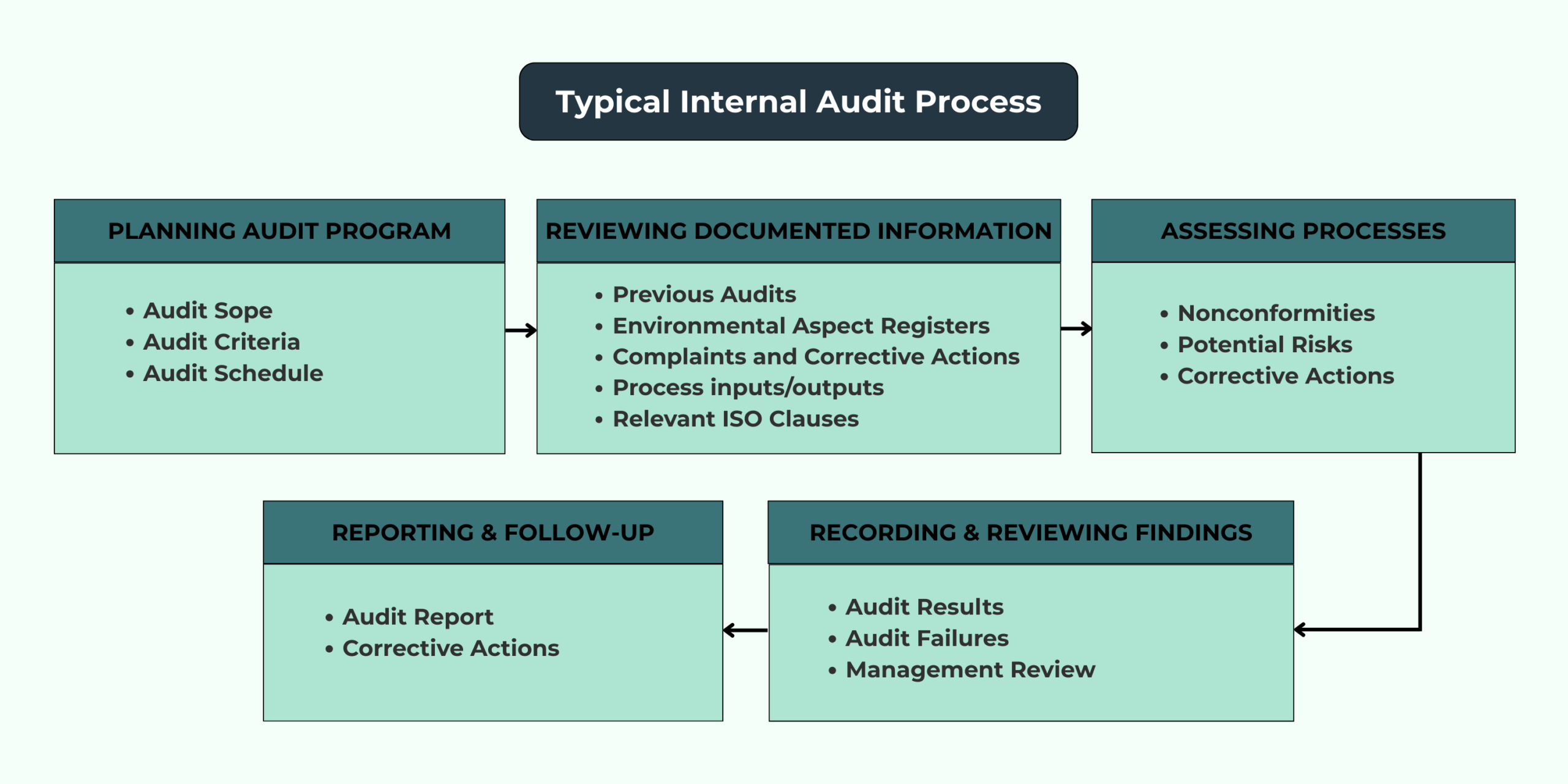
ISO 14001 Internal Audits
Internal audits are a fundamental requirement of ISO 14001:2015 and play a crucial role in verifying the effective implementation and continual improvement of your organization’s Environmental Management System (EMS). An effective internal audit program ensures both conformity to the organization’s own EMS requirements and to the ISO 14001 standard itself. The main audit approaches are classified into three categories:
- Product Audits – Assessment of whether products or services at key stages meet specified environmental requirements
- Process Audits – In-depth analysis of whether management systems are performing at desired outcomes and conforming to results
- System Audits – Overall quality and structure review of alignment with ISO 14001 standards
Purpose & Scope
Internal audits are conducted at planned intervals to:
- Confirm that the EMS conforms to both ISO 14001:2015 and the organization’s own requirements.
- Assess whether the EMS is effectively implemented and maintained to achieve intended outcomes.
- Identify nonconformities, determine corrective actions, and drive ongoing improvement.
Key Principles for ISO 14001 Internal Audits
- Independence and Objectivity: Auditors must be impartial and objective, avoiding auditing their own work.
- Evidence-Based Assessment: Findings must be supported by verifiable and documented evidence.
- Systematic Approach: Audits should follow established procedures, defined scope, and criteria to ensure comprehensive coverage.
Audit Program Requirements
Organizations must develop, implement, and maintain an internal audit program that addresses:
- Frequency and Scheduling: All EMS elements, processes, and relevant sites/functions must be audited on a planned basis, typically ensuring full coverage within a three-year cycle.
- Methods and Responsibilities: Define audit methods, team selection, and assignment of roles to maintain objectivity and impartiality.
- Planning and Reporting: Audit plans must clarify scope, objectives, and audit criteria. Results must be reported to relevant management.
- Audit Records: Document and retain evidence of the audit program and results, including schedules, reports, corrective actions, and follow-up activities.
When preparing the internal audit schedule, consider:
- Environmental significance of processes
- Results of previous audits
- Changes to operations, conformance obligations, or risks
Certification Body Expectations
During certification or surveillance audits, external auditors typically review the internal audit program and supporting documentation, including:
- The overall audit schedule (showing all elements covered over a three-year cycle)
- Audit plans, criteria, and checklists
- Evidence of audits performed and actions taken
- Auditor competence and impartiality documentation.
By implementing a robust internal audit program based on these principles and requirements, your organization will help ensure the continual conformity, effectiveness, and improvement of your Environmental Management System.
Key Timelines & Certification Process
ISO 14001 standards undergo periodic revisions, typically every 5-10 years, to reflect evolving best practices. Certified organizations are subject to annual surveillance audits to verify ongoing conformance, along with a recertification audit every three years. While ISO certification process is optional, many organizations acquire it as an additional layer of confidence that their EMS meets international standards.
The certification process generally includes:
- Gap analysis
- EMS implementation according to ISO 14001 requirements
- Internal audits
- Management reviews
- External certification audit
External certification audits are typically completed in two separate parts:
- Stage 1 (“Desk-top Study”) – A preliminary audit to assess readiness, identify gaps, and determine whether organization can proceed to final certification stage.
- Stage 2 (On-site Audit) – A site visit that includes operator interviews, observations, and document reviews to ensure that ISO 14001 requirements are met and any non-conformities are addressed through corrective action.
ISO 14001 Program Development & Support
An effective EMS under ISO 14001 provides a structured framework for improving environmental performance and achieving regulatory conformance. SEC provides tailored ISO consulting services to help your organization ensure ISO 14001 conformance, navigate the certification processes with confidence, and drive continuous improvements aligned with your business goals.
Need Support Adopting ISO 14001?
Please do not hesitate to reach out via the “Get a Quote” button below! We are eager to help your organization build a sustainable EMS and maintain ISO 14001 conformance with confidence.

Serving the Southeast
NASHVILLE | CHATTANOOGA | BIRMINGHAM
Serving the Southeast
NASHVILLE | CHATTANOOGA | BIRMINGHAM
NASHVILLE
CHATTANOOGA
BIRMINGHAM